Bedtime Routine Chart Printable: Free Chart and Step Cards for Kids
A free printable bedtime routine chart for kids: 10 steps in order with a tick box for each night, times for screens off and lights out, plus step cards.
Some links in this guide are affiliate links. If you buy through them we may earn a commission, at no extra cost to you. It never changes what we recommend, and we always point out free options built into your devices. As an Amazon Associate we earn from qualifying purchases.How this works.
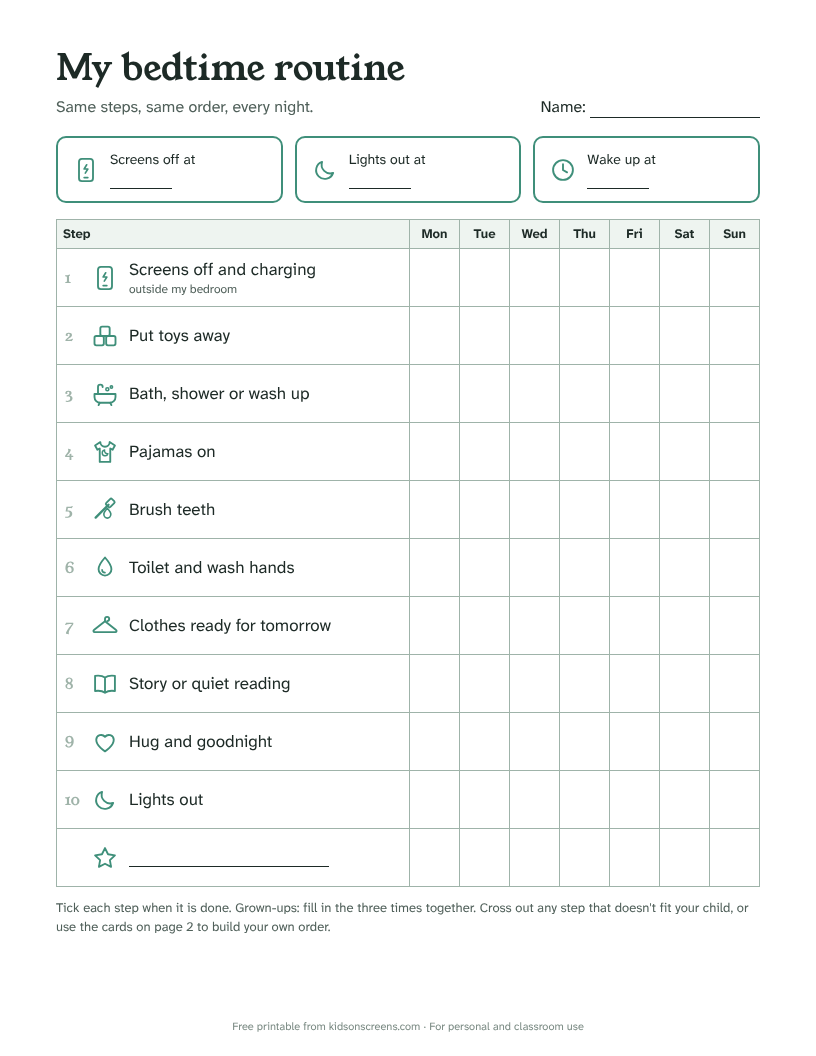
This free printable bedtime routine chart puts the evening in order: ten simple steps, from “screens off and charging” to “lights out”, with a box to tick each night of the week. At the top you fill in three times together: screens off, lights out and wake up. Page 2 has picture step cards to cut out, so younger kids who can’t read yet can build their own routine on the wall.
What’s in the printable
Two US Letter pages:
| Page | What’s on it |
|---|---|
| 1. My bedtime routine | Times for screens off, lights out and wake up; 10 numbered steps with simple pictures and a tick box for Monday to Sunday; one blank row for your own step |
| 2. Bedtime step cards | 11 picture cards (screens off, toys away, bath time, pajamas on, brush teeth, toilet and wash hands, clothes for tomorrow, pack my bag, story time, hug and goodnight, lights out) and 5 blank cards |
Why a set routine helps
The American Academy of Pediatrics says that “all children thrive on a regular bedtime routine”, and for young children it suggests starting early with a routine “such as brush, book, bed” (AAP, HealthyChildren.org). The same page lists the same waking time on weekdays and weekends as one of the habits that help a child feel secure and get to bed smoothly, which is why the chart has a wake-up time next to the lights-out time.
The chart doesn’t promise a child who falls asleep on cue. What it does is take the nightly reminders off your plate: the steps are on the wall, in the same order every night, and your child can see what comes next.
Why screens come first
Step 1 is “Screens off and charging, outside my bedroom”. The AAP recommends keeping all screens, including TVs, computers, tablets and phones, out of children’s bedrooms, especially at night, and turning off all screens at least an hour before bedtime (AAP). Its family media plan also suggests screen-free zones “such as the dinner table, during homework and before bed” (AAP family media plan).
So write the “screens off” time about an hour before “lights out”, and pick a charging spot outside the bedroom. If you want the device to help, you can schedule it too: our iPhone Screen Time guide shows how to set the hours apps can be used, and in Google Family Link, Downtime is under Screen time > Schedules (Google Family Link help; see our Family Link setup guide). A schedule turns the device off; the chart is what gets your child to the bathroom, the pajamas and the book.
If the phone or tablet was your child’s alarm clock, a simple alarm clock keeps it out of the bedroom. You can find kids’ alarm clocks on Amazon, or use any old clock you already have.
How to use the chart
- Fill in the three times together. Agree on when screens go off, when the lights go out and when your child wakes up. The AAP has a chart of recommended sleep hours by age on the same page; count back from the wake-up time.
- Cross out and add. Remove any step you don’t do (not every child bathes every night) and write one of your own in the blank row.
- Hang it where the routine happens. The bathroom door or next to the bed works better than the fridge, because that’s where the steps are.
- Tick, don’t score. Let your child tick each step. A missed box isn’t a punishment, just a reminder for tomorrow night.
- Keep it the same while traveling. The AAP suggests using sleep routines that “can be used anywhere”. Fold the cards for your bag; the same steps work at grandma’s house.
Using the step cards
The cards on page 2 are for kids who can’t read yet, or for families who want their own order. Cut out the steps you use and stick them in a row on the wall, on the bedroom door or along a ribbon with clothes pins. Your child can turn each card over or move it to a “done” pocket as they go. Use the blank cards for steps that only your family has, like feeding the cat or a glass of water.
Make it fit your child’s age
| Age | What to change |
|---|---|
| 3 to 5 | Use four or five step cards instead of the full chart, for example the AAP’s “brush, book, bed” plus pajamas and lights out. Do the steps together. |
| 6 to 8 | Use the chart as printed. Let your child tick the boxes and choose the story. |
| 9 to 10 | Ask your child to suggest the times and one step of their own, then agree them together. Swap “story” for quiet reading on their own. |
When bedtime still drags
Stalling and resisting bed are among the most common sleep problems the AAP lists, and it suggests talking with your pediatrician about sleep habits and problems, since “most sleep problems are easily treated”. Small changes on the chart can help too: move “screens off” earlier, take a step out, or dim the lights before bedtime as the AAP suggests.
For the rest of the day, our daily routine chart covers the morning and after school on one page, and the family screen time rules poster puts “screens rest before bed” alongside the other house rules.
Questions parents ask
How many pages is the bedtime routine chart?
Two US Letter pages. Page 1 is the weekly chart with 10 steps, a blank row and the three times; page 2 has 11 picture step cards and 5 blank cards to cut out. It also prints on A4 if you choose 'Fit to page' in your printer settings.
What time should my child go to bed?
It depends on when your child needs to wake up and how much sleep they need at their age. The American Academy of Pediatrics publishes recommended sleep hours by age on HealthyChildren.org; count back from the wake-up time and write the lights-out time on the chart.
Does my child need all 10 steps?
No. Cross out steps you don't use, add your own in the blank row, or use the cards on page 2 to build a short routine. For young children the AAP gives a three-step example: brush, book, bed.
Why is 'screens off' the first step?
The AAP suggests turning off all screens at least an hour before bedtime and keeping screens out of children's bedrooms, especially at night. Putting it first gives the rest of the routine time to happen without screens.