Free Printable Phone Contract for Kids (Family Phone Agreement)
A free one-page phone contract for kids and parents: rules for both sides, phone hours, where the phone charges at night, and what happens if a rule is broken.
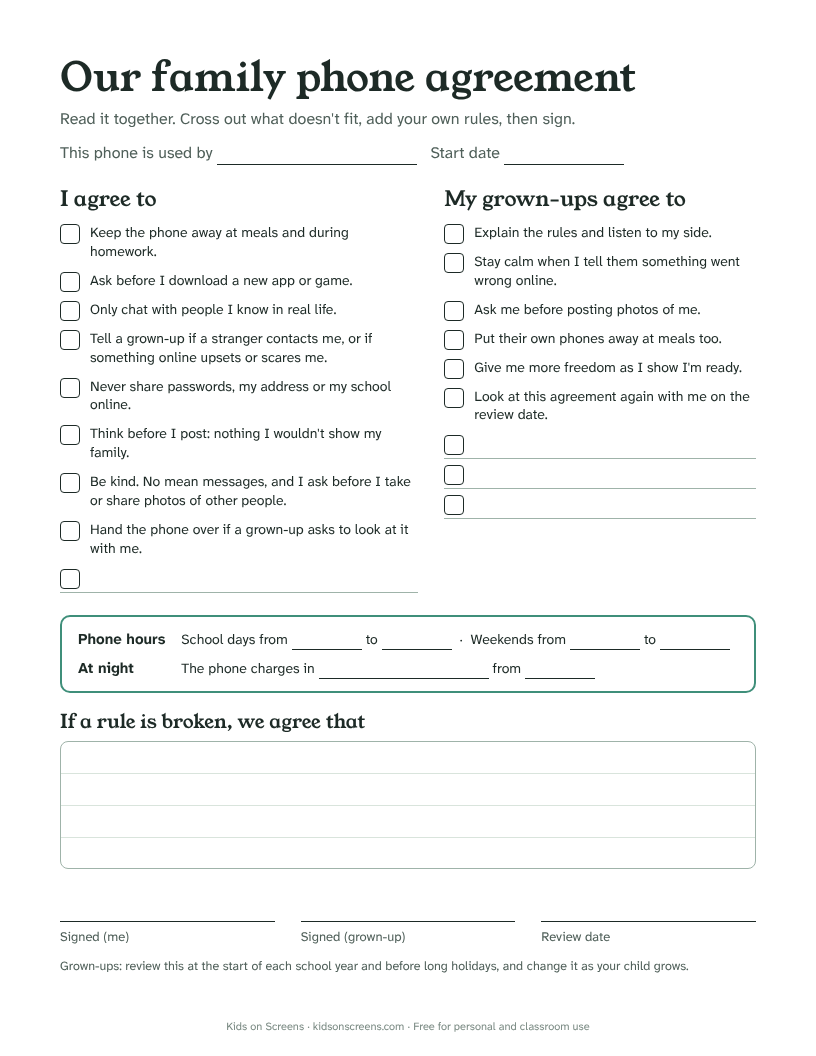
This one-page phone contract helps you and your child agree the rules before the phone arrives. It has two columns of promises, one for your child and one for the grown-ups, plus phone hours, where the phone charges at night, what happens if a rule is broken, and a place for everyone to sign.
What’s on the agreement
- “I agree to”: eight short rules for your child, from asking before downloading an app to telling a grown-up when something online feels wrong. There’s a blank line for your own.
- “My grown-ups agree to”: six promises from parents, like staying calm when your child reports a problem and putting phones away at meals too. Three blank lines leave room for more.
- Phone hours: fill in the times for school days and weekends.
- At night: where the phone charges, and from what time.
- If a rule is broken: a box to write the consequence you agree together.
- Signatures and a review date.
How to use it
- Print it before the phone is handed over. Rules are easier to agree while the phone is still in the box.
- Read every line out loud together. Cross out what doesn’t fit your child’s age and add your own rules on the blank lines.
- Agree the numbers. Fill in the phone hours and the charging spot together. A place outside the bedroom, like the kitchen, works for many families.
- Agree what happens if a rule is broken. Keep it short and predictable, and write it in the box.
- Sign it and put it somewhere you can both see it, then set the review date.
Why the grown-ups sign too
The American Academy of Pediatrics suggests making a family media plan “for every member of your family”, parents included, and calls parents an important role model for healthy digital habits (AAP, HealthyChildren.org). A promise from parents, like no phones at the dinner table for anyone, makes the agreement feel fair, and children are more likely to stick to rules they helped write.
The AAP also suggests talking through the rules with your kids, setting screen-free zones such as the dinner table and homework time, and checking privacy settings before your child uses a new app.
Back the agreement up with the phone’s settings
A written agreement works best when the phone’s settings match it. If you agree “phone off at 8:30 pm”, set the same time on the phone:
- On iPhone, use the available hours and time allowances in Screen Time. See how to set up Screen Time on your child’s iPhone.
- On Android, use downtime and app limits in Google Family Link. See how to set up Google Family Link.
- On iPad, see iPad parental controls.
- Giving the phone as a Christmas gift? See the setup checklist before you wrap it.
Settings can’t cover everything, such as being kind in group chats or not sharing photos of friends. That’s what the agreement is for.
Make it fit your child’s age
| Age | What to change |
|---|---|
| 8 to 10 | Keep the rules simple, and add “I only use the phone in shared rooms”. Read it together each week at first. |
| 11 to 13 | Use it as printed. Let your child suggest one rule for the grown-ups’ column. |
| 14 and up | Ask your teen to draft the rules and the phone hours, then agree them together. Give more freedom at each review. |
When to look at it again
The AAP recommends revisiting your family plan often, especially at the start of the school year and during summer and holiday breaks. Bring the agreement out at those times, loosen rules your child has shown they’re ready for, and sign a fresh copy.
Looking for more structure for the whole day? Our free daily routine chart has a box for the screen time you agree together. For rules that cover the whole family and every screen, not only the phone, print the family screen time rules poster.
Questions parents ask
At what age should we use a phone contract?
Whenever your child gets their first phone or first device of their own, often somewhere between 8 and 13. Older kids and teens can use it too: let them write more of the rules themselves.
Is a phone contract legally binding?
No. It's a family agreement, not a legal document. Its job is to make the rules clear and written down before there's an argument about them.
What should happen if a rule is broken?
Agree that together before you sign and write it in the box. Many families use a short, predictable step, such as the phone staying in the kitchen for the next evening, rather than a long ban.
Is a phone contract the same as a phone plan for kids?
No. This is a family agreement about how the phone is used, not a carrier plan or bundle. If you're still choosing the phone itself, a basic phone or a kids' smartwatch may be enough to start; our best first phone for kids guide compares kid phones, smartwatches and phone plans for kids with prices, and our Christmas first phone setup checklist covers the setup steps.
Can I edit the rules?
Yes. Cross out any line that doesn't fit, and use the blank lines in both columns for your own rules.
Planning a first phone? See every first-phone step in order.